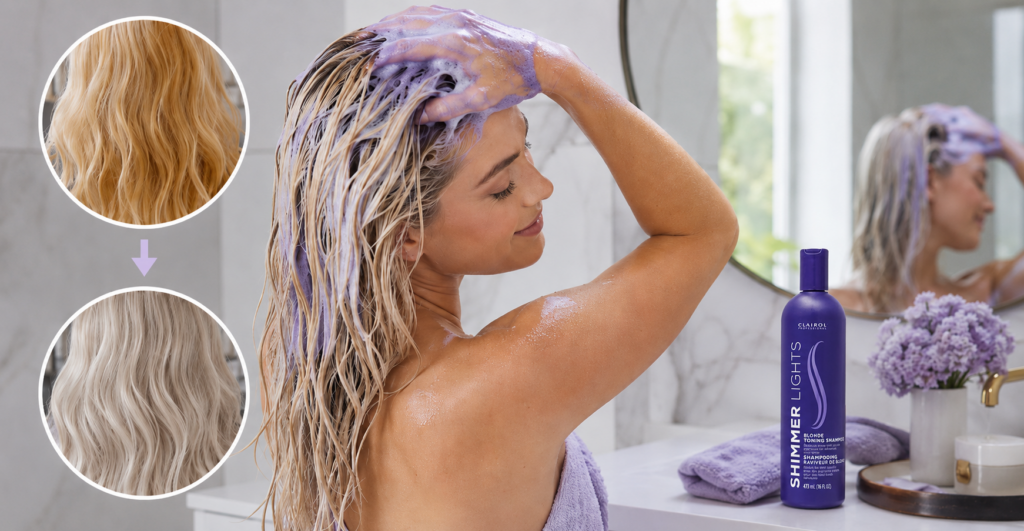
If your blonde looks more like a faded highlighter than a salon-fresh shade, you already know the fix everyone keeps recommending. The tricky part is figuring out how to use purple shampoo without ending up with patchy lavender ends, dried-out lengths, or a tone that’s somehow worse than where you started.
This guide walks through everything: what purple shampoo actually does, who it works best on, the right way to apply it, how long to leave it on, how often to wash with it, and how to clean things up if it stains your hair too cool. No fluff and no robotic talking points, just clear advice you can use the next time you step in the shower.
What Is Purple Shampoo?
Purple shampoo is a pigmented cleansing product designed to neutralize unwanted yellow and brassy tones in lightened hair. Instead of stripping color, it deposits a sheer layer of violet pigment onto the outside of each strand, which visually cancels the warmth that creeps into blonde, silver, gray, or highlighted hair over time.
It looks a bit alarming in the bottle (some formulas are nearly inky in color), but it isn’t a hair dye and it doesn’t lighten or darken your base shade. Think of it as an at-home toner in shampoo form, doing a small toning job during every wash so your color stays cool between salon visits.
Why is purple shampoo purple?
This is where color theory quietly does the heavy lifting. On the color wheel, purple sits directly across from yellow. They’re complementary colors, which means they cancel each other out when layered together. When your blonde looks yellow or golden, depositing violet pigment on top neutralizes that warmth and leaves the strand looking cooler, brighter, and closer to the ash blonde finish most people are after.
What is purple shampoo also called?
You’ll see it labeled as violet shampoo, silver shampoo (especially when marketed to gray hair), toning shampoo, brass-banishing shampoo, or anti-brass shampoo. The formulas are essentially the same idea: a cleanser with added violet dye that lifts unwanted warmth in lightened hair.
How Does Purple Shampoo Work?
Purple shampoo works through pigment deposit, not chemical reaction. The crushed violet pigments in the formula cling to the cuticle, which is the outermost layer of your hair. Because lightened hair is more porous than virgin hair, those pigments are absorbed enough to neutralize warm undertones for several washes before fading away.
Here’s a simple breakdown of the science behind it:
- Bleaching or highlighting lifts your natural pigment, but the underlying warm tones (yellow on lighter hair, orange on darker hair) don’t fully disappear.
- Environmental stress like chlorine, UV rays, hard water minerals, and even some heat styling reintroduces brassiness over time.
- The violet pigment in purple shampoo lands on the cuticle and visually offsets that warmth using the complementary color rule from color theory.
It’s worth knowing what purple shampoo can’t do. It won’t lift dark hair, it won’t darken light hair permanently, and it won’t fix uneven color or banding. It’s a maintenance step, not a color correction service.
How To Use Purple Shampoo Step By Step
The biggest reason people get bad results is that they treat purple shampoo like a regular shampoo. It isn’t. Here’s how to apply purple shampoo correctly and get the cool, even tone you actually want.
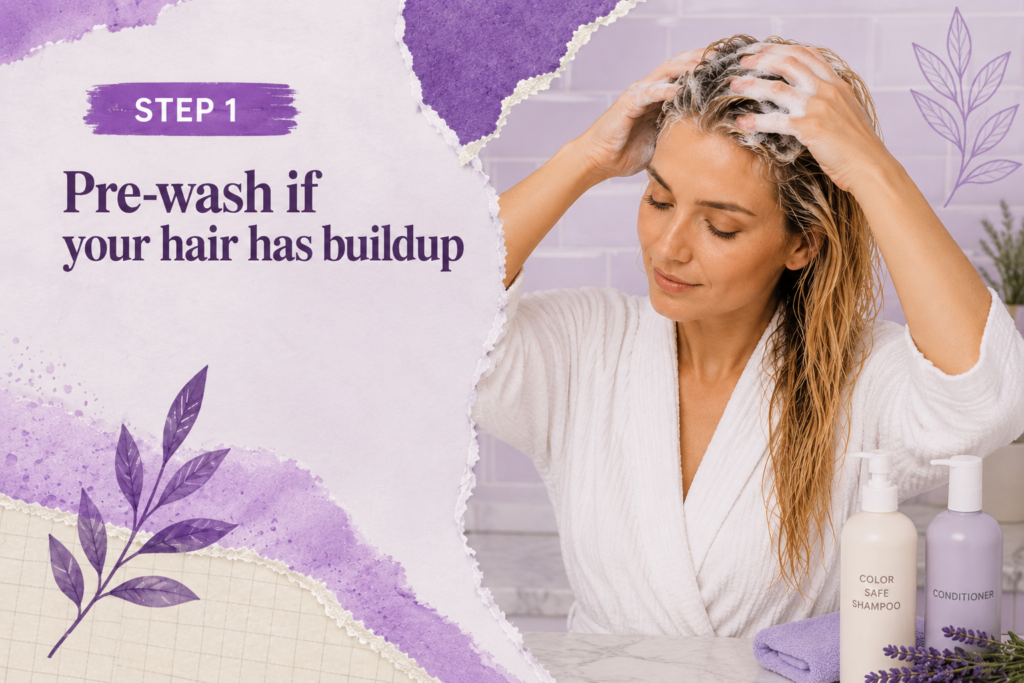
Step 1: Pre-wash if your hair has buildup
If your hair is heavy with oils, styling products, or hard-water minerals, the violet pigment won’t deposit evenly. Do a quick cleanse with your regular color-safe shampoo first, focusing on the roots. This clears the deck so the toning step lands smoothly.

Step 2: Get your hair damp, not soaking wet
Sopping wet hair dilutes the pigment and creates a slick barrier that prevents even deposit. Gently squeeze the excess water out with your hands or press your hair with a microfiber towel. The goal is damp, not dripping.
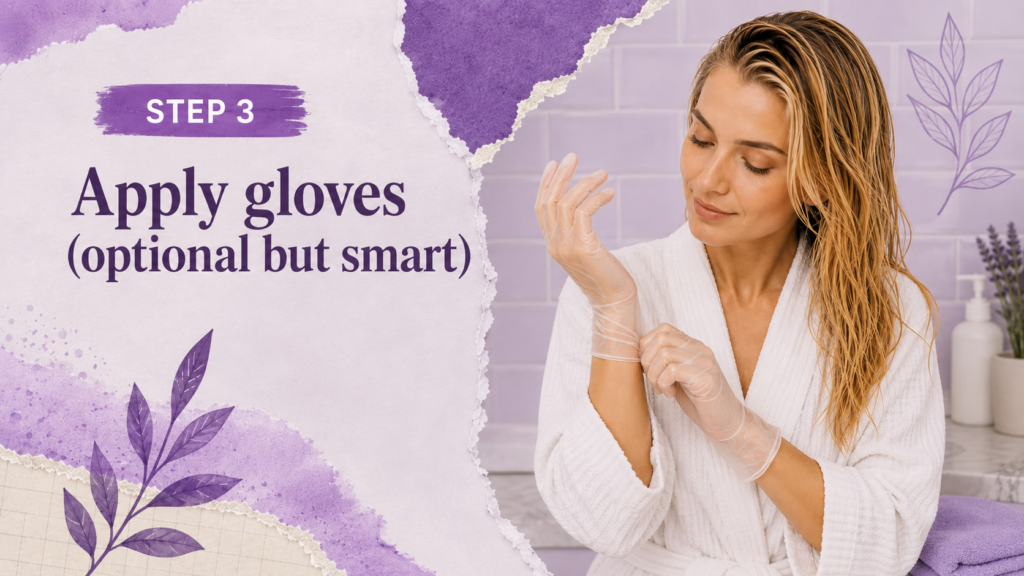
Step 3: Apply gloves (optional but smart)
Concentrated formulas can stain hands and nails for a day or two. If you’ve ever ended up explaining why your fingers look bruised, gloves solve that problem.

Step 4: Apply purple shampoo from mid-lengths to ends first
Start where brassiness is usually strongest, which is the mid-lengths and ends. Massage the formula in evenly, then work your way up to the roots. This order matters: the ends are more porous and need more pigment, while roots are usually fresher and need less.

Step 5: Comb through with your fingers
Distribute the lather evenly using your fingers or a wide-tooth comb. Patchy application is the number one cause of patchy results, so take the extra fifteen seconds to make sure every section is coated.
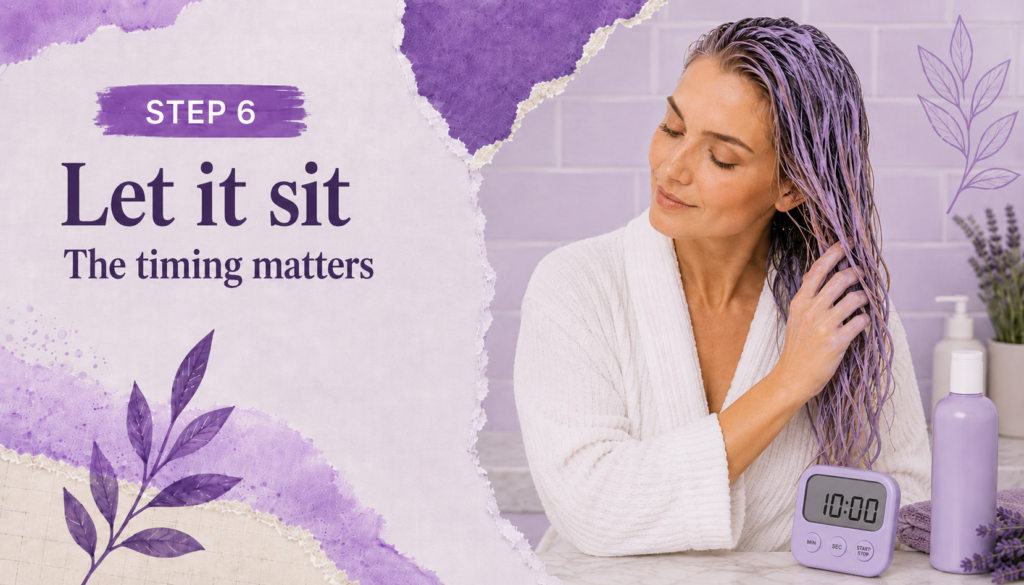
Step 6: Let it sit (the timing matters, see the next section)
Set a timer. Don’t guess. Don’t scroll your phone. Over-toning happens fast on porous hair, and a timer is the simplest way to avoid it.
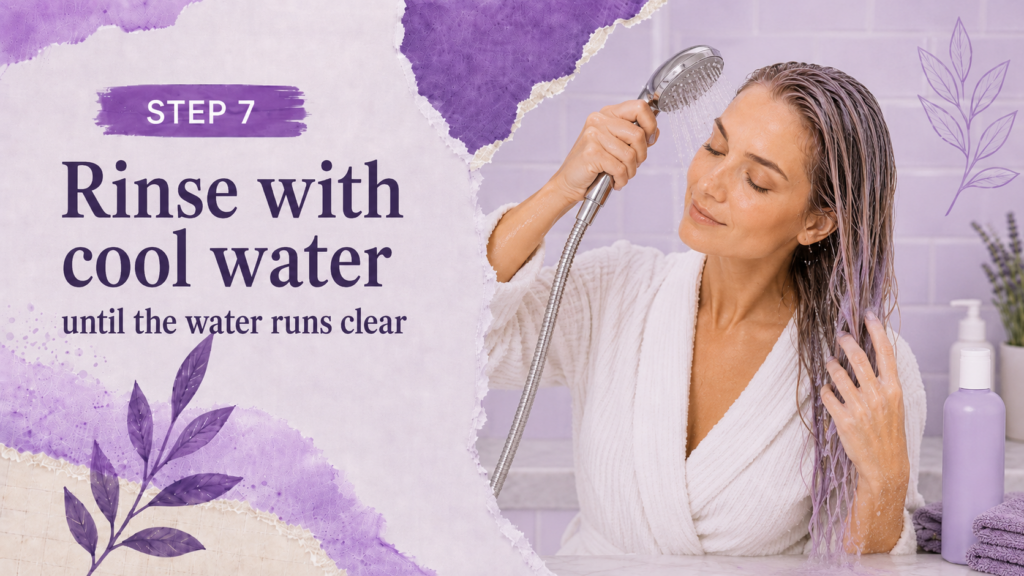
Step 7: Rinse with cool water
Rinse thoroughly with cool or lukewarm water until the water runs clear. Cool water helps seal the cuticle and lock in the tone. Hot water opens the cuticle and washes more of the pigment away.

Step 8: Follow with a hydrating conditioner
Always finish with a moisturizing or bond-repair conditioner. If your tone needs an extra boost, a purple conditioner can layer on more pigment with added hydration. For deeper repair, a weekly hair mask restores moisture that toning washes can pull out. And since most toning routines focus on the lengths, don’t ignore the root: a healthy scalp is what keeps blonde hair looking shiny and full, so pair your wash routine with these scalp care tips for healthier hair growth.
How Long Should You Leave Purple Shampoo In?
Most brands recommend somewhere between two and five minutes. That’s a useful starting range, but the right time depends on three things: your hair porosity, how brassy your hair currently looks, and how cool you want the final result.
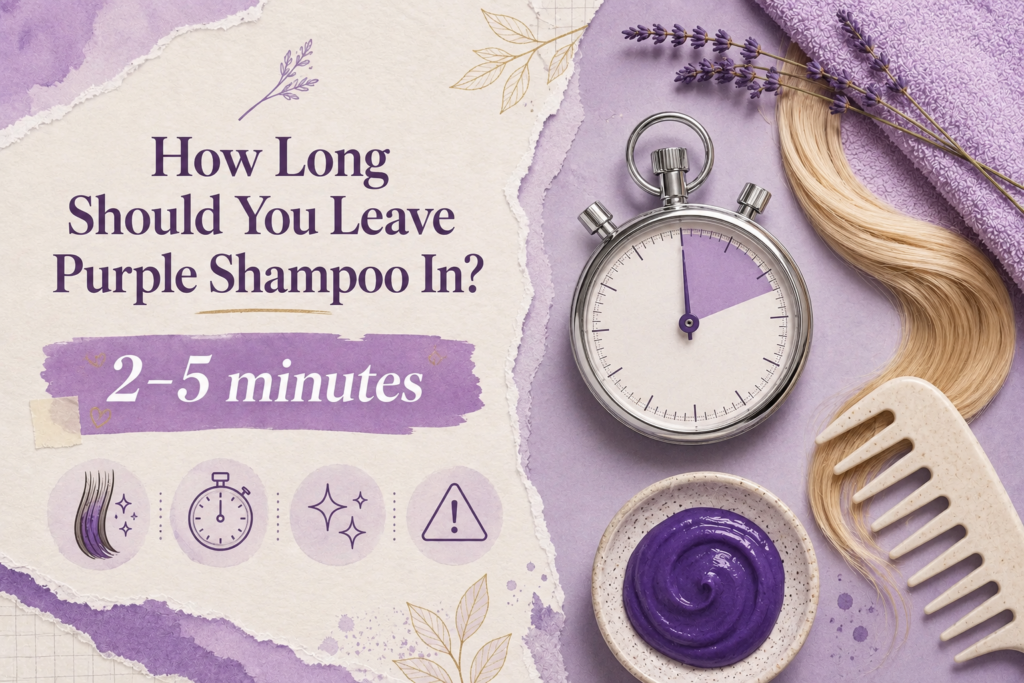
Here’s a practical timing guide based on what stylists and brands consistently recommend:
| Hair Situation | Recommended Time |
|---|---|
| First time using purple shampoo | 1 to 2 minutes |
| Natural blonde with light warmth | 2 to 3 minutes |
| Highlighted or balayage with mild brassiness | 3 to 5 minutes |
| Bleached blonde with stronger yellow tones | 5 to 10 minutes |
| Gray, silver, or white hair that’s gone yellow | 1 to 3 minutes (it absorbs pigment fast) |
| Coarse, low-porosity hair that resists toning | up to 10 minutes |
A few important rules around timing:
- Always do a strand test the first time, especially on a new brand. Start with the shorter end of the range. You can always go longer next wash if the result is too warm.
- Porous hair grabs pigment fast. If your hair has been bleached, heat-damaged, or feels rough, lean toward shorter times. Five minutes on porous hair can give the same result as fifteen minutes on healthier hair.
- Skip the hour-long social media trend. Some posts suggest leaving purple shampoo on for thirty minutes to an hour. It can work for very brassy, coarse hair, but for most people it leads to over-toning, dryness, or a visible lilac cast.
How Often Should You Use Purple Shampoo?
The honest answer: it depends on how fast your hair turns brassy and what shade you’re aiming for. There’s no single number that works for every blonde.
A useful framework:
- Warm blondes who like a hint of gold: Once every two weeks is plenty.
- Neutral blondes: Once a week is the standard recommendation.
- Cool, icy, or platinum blondes: Up to two or three times a week, depending on how quickly the warmth returns.
- Highlights, balayage, or ombré: Once a week, or whenever brass starts creeping in.
- Gray or silver hair: Once a week is usually enough, since gray hair absorbs pigment quickly.
Most stylists agree on one thing: purple shampoo should not replace your regular shampoo for daily use. The pigment builds up over time, and buildup is what causes hair to look dull, muted, or slightly purple. Treat it as a prescriptive treatment wash, not a daily staple. On the days you’re not toning, use a sulfate-free, color-safe shampoo to keep your hair clean and hydrated. For days when you want to stretch a style without another wash, our guide on how to use dry shampoo covers the right way to refresh oily roots without compromising your tone.
A practical rotation that works for most people: regular color-safe shampoo on most wash days, purple shampoo once a week as a tone refresh, and a hydrating mask once a week to keep your strands soft. Bleached and highlighted hair is naturally more fragile, so it’s worth pairing your toning routine with these ways to stop hair breakage before the snapped strands around your hairline turn into noticeable thinning.
Should You Use Purple Shampoo On Wet Or Dry Hair?
The vast majority of stylists and brands agree on this: purple shampoo should go on wet or damp hair, not dry hair.
There’s a trend online that recommends applying purple shampoo to bone-dry hair for “more intense” results. It exists for a reason (dry hair is more porous and pulls pigment faster), but it almost always causes uneven results. Dry hair doesn’t distribute the product evenly, and the more porous sections (usually the ends and any bleached pieces) soak up far more pigment than the rest. The likely outcome is a patchy, lavender finish that takes weeks to fade.
The safer approach is to apply purple shampoo to damp hair so the pigment spreads evenly and the timing stays predictable. If your tone needs more punch, lean on a purple mask or purple conditioner instead of dry application. You get stronger toning with built-in hydration, without the risk of an uneven cast.
Who Should Use Purple Shampoo?
Purple shampoo isn’t for every hair color. It’s most effective on hair that’s been lightened to a level eight or higher, which means blonde, platinum, silver, gray, white, and lightened brown hair.

Should blondes use purple shampoo?
Yes, this is exactly who the product is built for. Natural blondes, bleached blondes, dirty blondes, ash blondes, and platinum blondes all benefit. The shade you’re trying to keep determines the frequency: cooler shades need it more often, warmer shades need it less.
Can natural blondes use purple shampoo?
Yes. Natural blondes often develop yellow undertones from sun exposure, mineral buildup, or styling habits, even without dye or bleach. A weekly purple shampoo can refresh the tone and keep the shade looking clean.
Can dirty blondes use purple shampoo?
Yes, though the result is usually subtle. Dirty blondes have darker base tones, so the visible difference is smaller than on a true blonde. Used consistently, it can brighten and cool the lighter pieces around the face and through the lengths.
Can people with gray or silver hair use purple shampoo?
Yes, and it’s one of the best uses for it. Gray and silver hair turns yellow easily because the strands are more porous and react to environmental factors. A short toning wash (one to three minutes) brings back the cool, polished silver finish.
Should you use purple shampoo on red or copper hair?
Generally no. Purple shampoo neutralizes yellow, which can dull and muddy a vibrant red or copper shade. For red or copper hair, look for red-protecting shampoos or color-depositing red formulas instead.
Who should avoid purple shampoo?
If your hair is dark brown or black with no highlights, purple shampoo won’t do anything visible (your base tone is too dark for the pigment to register). It’s also worth skipping for the first two to three washes after a fresh salon toner, since the professional toner is still doing its job.
Can Brunettes Use Purple Shampoo?
Yes, but only some brunettes will see results. Whether purple shampoo works on brown hair depends entirely on how light your hair has been taken.
When purple shampoo works on brunettes
- You have balayage, highlights, babylights, or ombré that has turned yellow.
- You’ve lightened your base from dark brown to a medium or light brown (level eight or higher).
- You want to cool down the lighter pieces around your face without affecting your overall color.
When purple shampoo doesn’t do much for brunettes
- You have natural dark brown or black hair with no lightening.
- Your brassiness reads orange or red rather than yellow.
For brunettes with orange or red brassiness, blue shampoo is usually the better tool. Blue sits across from orange on the color wheel, which makes it more effective at canceling those deeper warm tones. Some brunettes alternate between purple and blue shampoo: blue for the orange tones at the base, purple for the yellow tones in the lighter pieces.
A note for brunettes: stick to once-a-week use at most, and never leave it on as long as a platinum blonde would. Dark hair is less forgiving when a purple cast appears.
Does Purple Shampoo Work On Orange Or Yellow Hair?
Let’s separate the two, because the answer is different.
Does purple shampoo tone yellow hair?
Yes, this is what purple shampoo is built to do. The violet pigment is the direct complementary color of yellow, so a few washes can knock out mild to moderate yellow tones in blonde, gray, or highlighted hair. The result is a cooler, brighter shade that reads more ash than gold.
For deeper yellow staining (like the warm cast that appears right after bleaching), purple shampoo helps, but it won’t fully replace a proper salon toner. Think of it as a fine-tuning tool, not a rescue tool.
Will purple shampoo tone orange hair?
This is where things get tricky. Purple shampoo is not the best fix for orange brassiness. Orange sits opposite blue on the color wheel, not purple, which means blue shampoo or a blue-violet toner is the more effective neutralizer.
That said, purple shampoo can help with light or mild orange tones (like a slightly orange tinge in highlights) because most purple shampoo formulas contain a small amount of blue pigment too. For deep, stubborn orange (like hair that lifted to a level six or seven and stalled there), don’t expect purple shampoo to fix it. The honest answer is that you probably need a salon toner or a blue-based product.
Purple Shampoo Vs Toner: What’s The Difference?
This is one of the most common points of confusion, so it’s worth being clear.
Purple shampoo is a pigment-depositing cleanser. It coats the cuticle with a sheer violet tint and washes out gradually. It’s gentle, gradual, and made for at-home maintenance between salon visits.
A salon toner is a color service. It’s mixed with a developer and applied like hair dye. The pigments penetrate past the cuticle, the results are immediate, and the effect typically lasts four to eight weeks before fading.
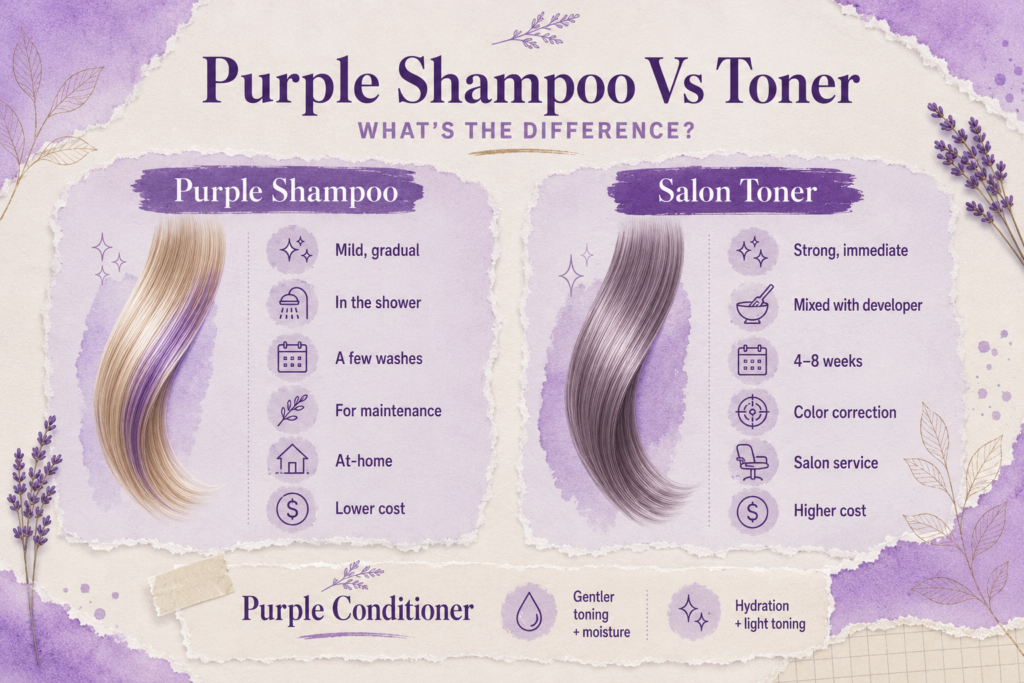
Side by side, here’s how they compare:
| Feature | Purple Shampoo | Salon Toner |
|---|---|---|
| Strength | Mild, gradual | Strong, immediate |
| Application | In the shower, like shampoo | Mixed with developer, applied like dye |
| Lasts | A few washes | 4 to 8 weeks |
| Best for | Mild brassiness, maintenance | Major color correction, fresh blonde lift |
| Where to get it | At-home product | Usually a salon service |
| Cost per use | Low | Higher (salon service) |
So is purple shampoo toner? Not exactly. It’s a toning shampoo, which performs a similar function on a smaller scale. The cleanest way to think about it: a salon toner sets your tone, and purple shampoo helps maintain it between visits.
Purple shampoo vs purple conditioner
These work together. Purple shampoo cleanses and tones, but it can be slightly drying. Purple conditioner adds moisture while depositing a smaller amount of violet pigment. The conditioner is gentler, so it’s useful for in-between weeks or for anyone who finds purple shampoo alone too harsh. A common routine is to alternate: purple shampoo plus purple conditioner once a week for stronger toning, and regular shampoo plus purple conditioner mid-week for a lighter refresh.
Common Purple Shampoo Mistakes To Avoid
Most purple shampoo problems trace back to a handful of avoidable mistakes. Here’s what to watch out for.
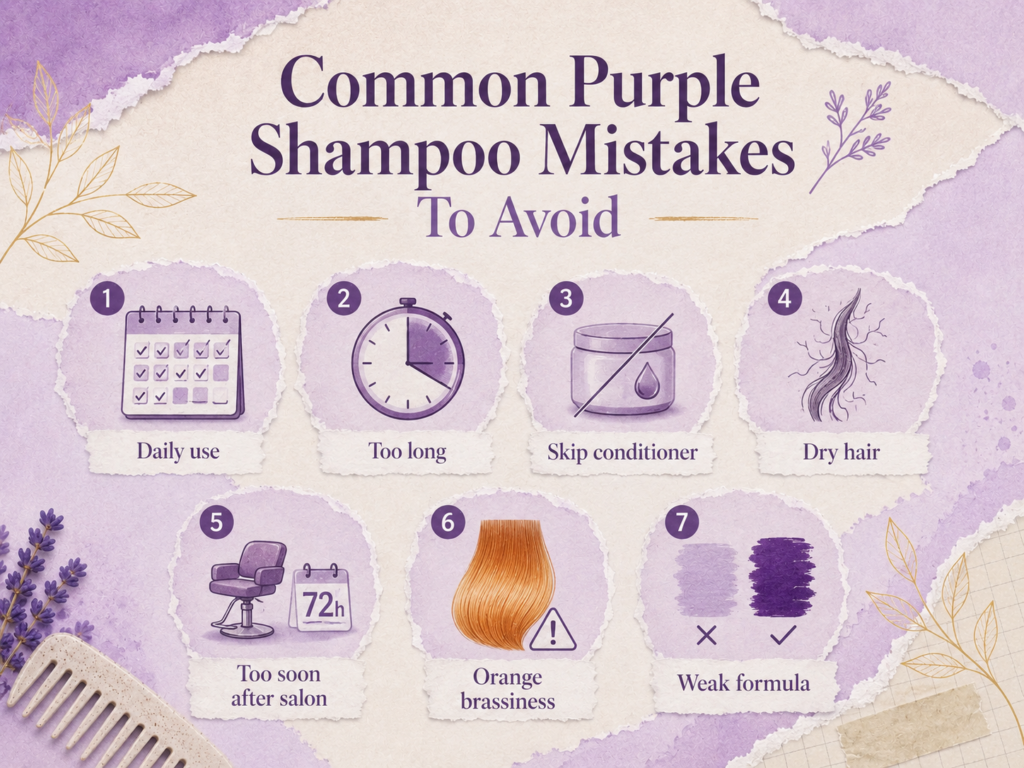
1. Using it as your daily shampoo
Daily use causes pigment buildup, which dulls your color and can leave a faint lilac cast. Treat it as a once-a-week treatment, not a routine cleanser.
2. Leaving it on too long
The instructions on the bottle exist for a reason. Leaving purple shampoo on for thirty minutes (or worse, overnight) can stain your hair purple, especially if your strands are porous. Set a timer every single time.
3. Skipping the conditioner
Toning shampoos are designed to deposit pigment, not to hydrate. Without a follow-up conditioner or mask, your hair can feel rough, tangly, or dry. Always pair it with a moisturizing step.
4. Applying it to bone-dry hair
The “dry hair trick” sounds good in theory but leads to patchy results. Always apply to damp hair for even distribution.
5. Using it too soon after a salon visit
A fresh salon toner needs time to settle. Most stylists recommend waiting at least 72 hours after bleaching or toning before adding purple shampoo into the routine. Otherwise, you’re stacking pigments on top of pigments and risking an over-cooled, muddy result.
6. Treating it like a fix for orange brassiness
If your brassiness is leaning orange or copper, purple isn’t the right tool. Reach for blue shampoo or a blue-violet toner instead.
7. Buying a low-pigment formula and expecting big results
A good purple shampoo is opaque and rich in color when you squeeze it onto your hand. Watery, pale formulas often don’t have enough pigment to actually neutralize warmth. Look for sulfate-free options with concentrated violet pigment, ideally paired with strengthening ingredients like keratin or bond-repair complexes.
Does purple shampoo ruin your hair?
Used correctly, no. The violet pigment sits on the outer layer of the hair and doesn’t penetrate the cortex, so it doesn’t structurally damage your strands. The issue is that some purple shampoos contain sulfates and can feel drying, especially on already bleached hair.
If your hair feels brittle after toning, switch to a sulfate-free formula and follow with a deep conditioner or weekly mask. The shampoo isn’t ruining your hair, but neglecting moisture might be. If you’re trying to grow your color out healthier and longer, these tips to make your hair grow faster cover the small habits that protect length over time.
Can purple shampoo irritate your scalp?
Most people tolerate purple shampoo without scalp issues, but anyone with a sensitive scalp or a sulfate sensitivity may experience tingling or dryness. A patch test on a small section before full use is a safe move, especially if you’re switching brands.
How To Fix Hair That Turned Purple From Purple Shampoo
If you’ve checked the mirror and realized your hair has tipped from cool blonde to soft lavender, don’t panic. The fix is easier than you think because purple shampoo isn’t a permanent dye. It washes out over time.
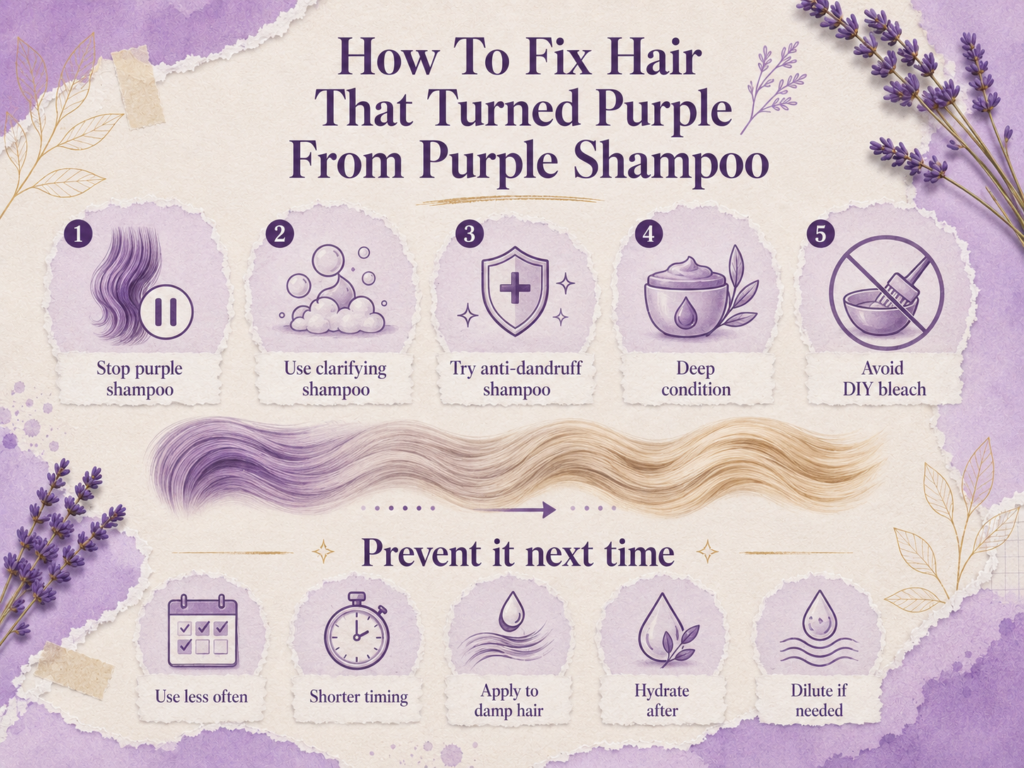
Step 1: Stop using purple shampoo immediately
The first move is to stop adding more pigment. Switch back to your regular color-safe shampoo and pause the purple treatments for at least two weeks.
Step 2: Wash with a clarifying shampoo
A clarifying shampoo is a deep-cleansing formula that strips product buildup, including violet pigment. Lather it in, leave it for two to three minutes, then rinse. You may need to repeat this for two or three washes before the purple fades fully.
Step 3: Try a gentle anti-dandruff shampoo as a backup
If you don’t have a clarifying shampoo on hand, an anti-dandruff shampoo works as a budget-friendly alternative. It contains stronger surfactants that break down pigment buildup more aggressively than a standard wash.
Step 4: Deep condition right after
Clarifying shampoos can be drying, especially on hair that’s already been bleached or toned. Always follow with a hydrating mask or deep conditioning treatment to put the moisture back. Look for masks with bond-repair ingredients to rebuild strength after multiple washes.
Step 5: Avoid DIY bleach fixes
It’s tempting to grab a box of bleach and “lift it out,” but this almost always makes things worse. Purple is a small problem; chemical damage from a home lightener is a much bigger one. If two or three clarifying washes don’t bring your tone back, visit a salon for a professional color correction.
How to prevent it from happening again
Once your hair is back to its cool blonde, tighten up your routine so it doesn’t repeat:
- Cut your purple shampoo frequency in half until you find the right rhythm
- Reduce the time it sits on your hair by one to two minutes
- Always apply to damp (not soaking wet) hair, evenly distributed
- Pair every toning wash with a hydrating conditioner or mask
- Dilute the shampoo with water in a 2:1 ratio if the formula is too strong for your hair
If you’d rather skip the store-bought formulas entirely and control exactly what touches your scalp, our walkthrough on how to make shampoo covers gentle, customizable recipes you can mix at home to pair with your toning routine.