You spray it on, your roots look fresh, you skip another wash day, and life feels manageable again. Then the question hits: does dry shampoo cause hair loss? The internet is split. Some posts say it’s perfectly safe, others share viral stories of bald patches and burning scalps.
The truth lives somewhere in the middle, and it depends almost entirely on how often you use it, what’s in your formula, and what’s happening on your scalp underneath all that product. This guide breaks down what the science says, what dermatologists warn about, what ingredients to watch out for, and how to keep using dry shampoo without putting your hair at risk.
Does Dry Shampoo Cause Hair Loss?
The short answer: dry shampoo itself does not directly cause hair loss in the way that genetics, medication, or hormones do. But it can absolutely contribute to hair shedding, breakage, and even temporary thinning when overused.
According to the American Academy of Dermatology, dry shampoo doesn’t actually clean your scalp. It contains absorbent particles like starch, alcohol, silica, or clay that soak up oil and make your hair look fresher. Nothing in that process lifts dirt, dead skin cells, or product residue off the scalp. That’s only what water and a real cleansing shampoo can do. When you skip washing for too long and rely on dry shampoo to bridge the gap, residue builds up around the hair follicle, and that buildup is where the trouble starts.
Dermatologists are clear that occasional use is safe for most people. The issue is daily or near-daily use, especially when paired with a sensitive scalp, an underlying skin condition, or an aggressive application method.
The dry shampoo and hair loss connection in plain terms
Think of it this way: hair loss isn’t a single problem. It’s an umbrella term for several different issues that can show up at the same time.
- Hair shedding is when more strands fall out than usual. Often temporary and linked to scalp inflammation or stress on the follicle.
- Hair breakage is when strands snap mid-shaft from dryness or friction, leaving short, broken pieces around your hairline. This isn’t true loss, but it visibly thins your hair (here are proven ways to stop hair breakage if you’re already seeing snapped strands).
- Follicle damage is when the actual root structure gets inflamed or scarred, which can lead to slowed regrowth or, in severe cases, permanent loss.
Dry shampoo is most often linked to the first two. The third is rare and usually only happens with extreme overuse, severe folliculitis, or untreated seborrheic dermatitis.
Can Dry Shampoo Cause Permanent Hair Loss?
Permanent hair loss from dry shampoo alone is extremely uncommon, but it isn’t impossible. The risk shows up in specific situations.
Most of the time, when people stop using dry shampoo and treat any scalp irritation properly, their hair recovers. But there are scenarios where damage can become long-term.
When the risk crosses into permanent territory
The follicle is the small pocket in your skin where each hair grows. When the follicle is healthy, hair grows out, sheds in a normal cycle, and grows back. When the follicle is repeatedly inflamed or infected, that cycle gets disrupted. If the inflammation becomes chronic, scar tissue can form around the follicle, which is called cicatricial alopecia or scarring alopecia. Once that scar tissue sets in, the follicle stops producing hair and the loss becomes permanent.
The path that gets you there usually looks like this: heavy daily dry shampoo use, no proper washing for weeks, scalp buildup, folliculitis sets in, the infection isn’t treated, inflammation becomes chronic, and scarring forms. That’s the rare worst-case scenario.
For nearly everyone else, the loss is temporary. According to dermatologists interviewed by TODAY.com, when you stop overusing dry shampoo and restore normal scalp hygiene, your hair should bounce back within a few weeks to a few months.
Why Dry Shampoo May Contribute To Hair Shedding
There are four main reasons dry shampoo can make hair fall out more than it should. Most of them connect back to scalp health rather than the product itself being toxic to your follicles.

1. Clogged hair follicles
The starches, polymers, and oil-absorbing particles in dry shampoo are designed to sit on your scalp until you wash them out. If you don’t wash regularly, those particles combine with sebum, sweat, dead skin cells, and other styling products. The result is a thick layer of buildup that can clog the opening of the hair follicle. Clogged follicles can’t receive proper oxygen, nutrients, or blood flow, and that disruption can slow down the natural growth phase of hair.
2. Folliculitis and scalp inflammation
When buildup traps bacteria or yeast against the scalp, the follicles can become inflamed or infected. This condition is called folliculitis, and it shows up as small red bumps, pus-filled spots, or a tender, itchy scalp. According to the Mayo Clinic and confirmed by dermatologists at Nebraska Medicine, folliculitis weakens the follicle’s anchor and can make hair fall out more easily. Repeated bouts of folliculitis are one of the most common ways dry shampoo overuse leads to noticeable shedding.
3. Hair breakage from dryness
Many dry shampoos contain denatured alcohol or isopropyl alcohol as part of their oil-absorbing formula. Alcohol works fast on grease, but it also pulls moisture from the hair shaft and the scalp. Over time, that drying effect makes strands more brittle, more prone to snapping, and more likely to fray at the ends. Combined with vigorous brushing to “work in” the product, this is where most breakage near the hairline and temples comes from.
4. Mechanical stress from rough application
A lot of people massage dry shampoo aggressively into their roots to blend out the white residue. That repeated friction at the same spots (usually the temples, hairline, and crown) can physically pull hairs out of the follicle. It isn’t true follicle damage, but it shows up as thinning in those exact spots, which is why some users complain about a receding-looking hairline after months of daily use.
How Overusing Dry Shampoo Affects The Scalp
Your scalp is skin, and like every other patch of skin on your body, it has its own ecosystem. It produces oil, sheds dead cells, and hosts a balanced mix of bacteria and fungi called the scalp microbiome. When that balance is disrupted, problems show up. (For a deeper look at keeping your roots healthy, check out our guide to scalp care tips for healthier hair growth.)

Buildup creates a domino effect
Here’s what happens when dry shampoo accumulates over multiple days without being washed out properly:
- Layer one: dry shampoo residue mixes with sebum and forms a waxy film
- Layer two: dead skin cells get trapped in that film instead of shedding normally
- Layer three: sweat and environmental dirt stick to the surface
- Layer four: bacteria and yeast like Malassezia feed on the trapped oil and multiply
The end result is a scalp environment that’s both clogged and inflamed. You may notice symptoms before you see thinning: itching, flaking that looks like dandruff but isn’t, redness, tightness, or a faint sour smell when you touch your scalp.
The dandruff confusion
Many people who overuse dry shampoo think they’re suddenly developing dandruff. In reality, what they’re seeing is often a mix of undissolved dry shampoo particles and dead skin held together by oil. Switching to a stronger anti-dandruff product without addressing the buildup usually doesn’t help. A clarifying shampoo or a scalp scrub is what actually resets the situation.
Scalp conditions that get worse
If you already have seborrheic dermatitis, eczema, psoriasis, or sensitive skin, dry shampoo overuse can flare your symptoms fast. Dermatologists specifically advise people with these conditions to either avoid dry shampoo entirely or use it sparingly and with a fragrance-free formula. The same applies if you’re using any topical prescription medication on your scalp, since dry shampoo residue can interfere with how those medications absorb.
What Ingredients In Shampoo Can Cause Hair Loss?
Not every dry shampoo is created with the same ingredient list, and some of the more aggressive components are worth knowing about before you buy.
Ingredients linked to scalp irritation and hair issues
Denatured alcohol and isopropyl alcohol. These dry out the scalp and hair shaft. Useful for oil absorption, but harsh on a daily basis.
Butane, isobutane, and propane. These are the aerosol propellants in most spray dry shampoos. They’re flammable, can irritate sensitive skin, and have been flagged in safety reviews for both their environmental and skin-contact concerns.
Synthetic fragrances and phthalates. Some “fragrance” listings hide multiple chemical compounds that can trigger contact dermatitis. Fragrance is one of the most common scalp allergens.
Talc. Used as an absorbent in some powder formulas. Cosmetic-grade purified talc is generally considered safe, but raw or unpurified talc has historically been a source of contamination concerns.
Parabens and certain preservatives. These can disrupt scalp pH and, for some sensitive people, trigger irritation or allergic reactions over time.
Silicones like dimethicone in conditioning sprays. Not in every dry shampoo, but when present, they can coat the scalp and add to buildup if not washed out thoroughly.
Benzene and the 2022 FDA recall
This is the ingredient that put dry shampoo in the news in a big way. In late 2022, the U.S. Food and Drug Administration announced that benzene, a known carcinogen, was detected in several major aerosol dry shampoo brands. This led to a voluntary recall affecting products from Unilever brands including Suave, Dove, Nexxus, TRESemmé, and Bed Head. Benzene isn’t supposed to be in dry shampoo at all. It got there as a contaminant from the propellants used in aerosol cans.
Benzene isn’t directly linked to hair loss, but the recall raised legitimate questions about overall safety. If you have a dry shampoo from before 2023 sitting in your bathroom cabinet, the safest move is to discard it. Look for products labeled “benzene-free” or switch to non-aerosol powder versions to eliminate that concern entirely.
What about traditional shampoo ingredients?
Many of the same concerns apply to regular shampoo. Sulfates like sodium lauryl sulfate can strip natural oils and weaken the hair shaft over time. Parabens and synthetic fragrances can irritate the scalp. Formaldehyde-releasing preservatives are linked to hair breakage in some research. If you’re worried about your overall haircare routine, scan the labels on every product touching your scalp, not just the dry shampoo can.
Signs Dry Shampoo Is Irritating Your Scalp
Your scalp usually warns you before things get serious. The trick is catching the early signs and responding before buildup turns into folliculitis or shedding.
Watch for these red flags
Itching that won’t go away. A persistent itch, especially at the crown or behind the ears, is often the first sign that residue is irritating the skin.
Flaking and visible residue. Small white particles that don’t brush out, or thicker yellowish flakes, are signs that dry shampoo is layering on top of dead skin cells.
Tenderness or burning. A sore feeling when you touch your scalp, or a burning sensation in the shower, suggests inflammation is setting in.
Small red bumps or pimples. Bumps along the hairline, around the part, or at the back of the neck can be early-stage folliculitis.
Increased shedding when you brush or wash. Losing more strands than your usual baseline, especially clumps in the drain after a shower, is a clear signal something is off.
A scalp that smells off. A sour, musty, or otherwise unusual smell at the roots usually means trapped bacteria and yeast are multiplying.
Hair that feels heavy, dull, or limp. Even if your hair looks “clean” from dry shampoo, weighed-down strands that won’t hold style are a sign of buildup.
If you see two or more of these signs at the same time, treat it as a clear message from your scalp to pause the dry shampoo, do a thorough wash, and reset your routine.
How Often Should You Use Dry Shampoo Safely?
This is where most people go wrong. Dry shampoo was never designed to replace washing your hair, and the brands themselves consistently say so. The safe rule of thumb from most dermatologists and trichologists is once or twice a week maximum, and never more than two days in a row.
A realistic safe-use schedule
Here’s a usage pattern that keeps your scalp healthy while still giving you the convenience benefit:
| Wash Routine | Safe Dry Shampoo Use |
|---|---|
| Washing hair 3-4 times a week | Use dry shampoo on 1-2 non-wash days |
| Washing hair 2 times a week | Use dry shampoo on 1-2 days between washes |
| Washing hair once a week | Use dry shampoo on 1 day, ideally mid-week |
| Daily wash | Skip dry shampoo unless needed for styling |
Some additional rules that experts agree on:
- Never use dry shampoo on more than two consecutive days
- Always wash thoroughly within 24 to 48 hours of your last dry shampoo application
- If you work out heavily, sweat means you need a proper wash, not more dry shampoo
- Apply at night when possible, so the product has time to absorb oil before your hair gets touched in the morning
Application matters as much as frequency
Even at the right frequency, technique can ruin your scalp. If you want a full walkthrough, our complete guide on how to use dry shampoo covers timing, distance, and brushing technique in detail. The short version is what most dermatologists recommend:
- Hold the can six to eight inches from your scalp
- Spray in short bursts at the roots, not in one continuous blast
- Focus only on the oily areas (usually the crown and temples)
- Wait two to three minutes before brushing or massaging in
- Use a soft brush to redistribute the product, not your fingers grinding into your scalp
Aggressive scrubbing of dry shampoo into your roots is one of the fastest ways to cause hair breakage and irritate the skin.
How To Prevent Hair Loss While Using Dry Shampoo
You don’t have to quit dry shampoo to keep your hair healthy. You just have to be smarter about how, when, and how often you use it. Here’s a practical playbook.
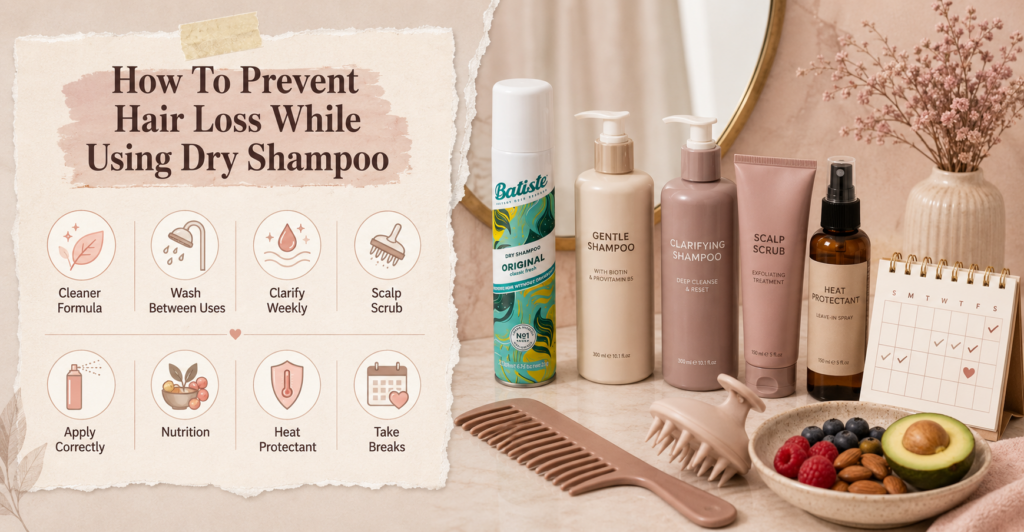
1. Switch to a cleaner formula
Look for these on the label:
- Benzene-free
- Sulfate-free
- Fragrance-free or naturally scented with essential oils
- Made with rice starch, tapioca starch, or kaolin clay as the main absorber
- Non-aerosol if you want to avoid propellants entirely
Powder dry shampoos applied with a brush or fingers are usually gentler than aerosol sprays because you control exactly how much product goes on your scalp. If you prefer a fully DIY approach, our step-by-step guide on how to make shampoo walks through gentle, scalp-friendly formulas you can mix at home.
2. Wash your hair properly between uses
A regular wash with a gentle, sulfate-free shampoo is non-negotiable. Make sure you massage your scalp with your fingertips (not your nails) for at least 60 seconds to lift residue. Rinse until the water runs completely clear. If your scalp still feels coated, do a second lather.
3. Add a clarifying shampoo once a week
A weekly deep cleanse with a clarifying shampoo is the most reliable way to prevent buildup. These formulas use stronger surfactants to dissolve product residue, mineral deposits from hard water, and any leftover dry shampoo. Use it once a week, no more, because clarifying shampoos can be drying if overused.
4. Try a scalp scrub or scalp brush
Physical exfoliation helps lift residue that even a regular shampoo can miss. A scalp scrub with salicylic acid or fine granules used once a week, or a silicone scalp massage brush during your shampoo, both work well. The goal is to gently break up buildup at the root.
5. Apply dry shampoo correctly
Hold the can or bottle at a distance. Spray in short bursts. Target oily zones only. Wait before touching your hair. Brush, don’t grind. These small adjustments make a real difference in how much residue ends up on your scalp.
6. Strengthen your hair from the inside
Healthy hair growth depends on more than what you put on it. A balanced diet rich in biotin, iron, zinc, vitamin D, and omega-3 fatty acids supports the hair follicle from within. If you’ve been shedding more than usual, ask a doctor to check for iron deficiency, thyroid issues, or vitamin D levels, since these are some of the most common medical causes of hair loss that get blamed on hair products. For more day-to-day habits that actually move the needle, our roundup of tips to make your hair grow faster covers everything from nutrition to scalp stimulation.
7. Use heat protection if you’re styling
If you blow-dry, curl, or straighten your hair on top of dry shampoo, the heat can interact with the product and amplify dryness. Always use a heat protectant spray before any thermal styling.
8. Take dry shampoo breaks
Every few weeks, give your scalp a complete rest from dry shampoo for seven to ten days. Wash your hair on your normal schedule, deep condition once, and let your scalp’s natural balance reset. This periodic reset prevents long-term buildup and keeps your follicles healthier.
When To Stop Using Dry Shampoo
There’s a clear line between “occasional irritation” and “your scalp is telling you to stop.” Listen to your scalp, and stop using dry shampoo entirely if any of the following are true.
Stop immediately if you notice
- Persistent scalp itching that doesn’t go away after a proper wash
- Burning, tenderness, or pain in the scalp, especially at the spots where you spray most
- Bald patches or noticeably thinning areas, particularly around the temples, crown, or hairline
- Pus-filled bumps or infected-looking spots that suggest folliculitis
- Excessive shedding beyond your normal daily loss of 50 to 100 strands
- Sores or blisters on the scalp, which need medical attention
- A worsening of any existing scalp condition like dandruff, seborrheic dermatitis, or psoriasis
Don’t restart until your scalp is fully clear
If you’ve been using dry shampoo heavily and you’re experiencing symptoms, take a real break. Most dermatologists recommend stopping for at least three to four weeks while you also do the following:
- Wash regularly with a gentle, fragrance-free shampoo
- Use a clarifying wash twice during the break to remove deep buildup
- Apply a hydrating scalp serum or lightweight oil to restore moisture
- Avoid heavy styling products that could keep the buildup cycle going
If symptoms don’t clear after a few weeks of no dry shampoo and a gentler routine, see a dermatologist or a trichologist. Persistent shedding or scalp inflammation could point to an underlying issue that has nothing to do with dry shampoo, such as telogen effluvium, androgenetic alopecia, thyroid imbalance, or nutritional deficiency. A professional can run the right tests and give you a clear answer instead of leaving you to guess.
Long-term takeaway
Dry shampoo, used the right way, isn’t going to ruin your hair. It’s a useful tool when you need to extend a blowout, save time between washes, or refresh a workout look.
The danger isn’t the product itself, it’s the habit of relying on it instead of properly cleansing your scalp. Treat it like what it is: a quick fix, not a substitute. Wash your hair on a regular schedule, pick a clean formula, and pay attention to what your scalp is telling you. Those three habits keep nearly everyone in the clear.